We study how climate and other environmental changes affect ecosystems, resources, and society, and how those risks can be understood and managed

The Global Environmental Change Lab at UC Davis, led by Professor Erwan Monier, develops and applies quantitative approaches to understand how climate and other environmental stressors affect Earth systems, ecosystems, and society.
We combine climate and Earth system science, process-based modeling, data science, observational analysis, and impact assessment to investigate environmental change across scales—from physical and biogeochemical processes to impacts on agriculture, water resources, ecosystems, air quality, and human health.
The questions that guide our research
Our research is organized around three interconnected questions.
-
How is the Earth system changing?
We investigate how climate variability and change, extreme events, land use, pollution, and other human influences alter the physical, ecological, and biogeochemical processes that govern the Earth system.
Our work examines changes in terrestrial and marine ecosystems, wildfire, and global and regional biogeochemical cycles, including carbon, nitrogen, and mercury.
Examples: climate and weather extremes • terrestrial ecosystems • marine ecosystems • wildfire • carbon cycle • biogeochemical cycling -
How do those changes propagate through coupled human–Earth systems?
Environmental change creates consequences that extend far beyond the physical climate system. We study how changes in climate and ecosystems propagate through agriculture, water resources, air quality, human health, biodiversity, and other interconnected natural and human systems.
By linking environmental drivers with system responses, we seek to understand not only where impacts occur, but also the processes and interactions that create them.
Examples: agriculture and food systems • water resources • forests • air quality • human health • ecosystem services -
How can we quantify risk and enable adaptation?
We develop modeling and analytical frameworks to characterize risk, uncertainty, resilience, and adaptation under environmental change.
Our work integrates process-based models, empirical and statistical approaches, large observational datasets, and high-performance computing to evaluate future risks, test adaptation strategies, and provide actionable information for communities, ecosystems, and decision makers.
Examples: climate-risk assessment • uncertainty analysis • adaptation • resilience • scenario analysis • decision support
Modeling platforms
The lab develops and applies complementary modeling platforms to investigate different components of this system. For example, our Lab contributes to the development of the Global Dynamical and Structural Terrestrial Ecosystem Model (GDSTEM) that supports research on terrestrial ecosystems, carbon cycling, land-use change, and wildfire. We have also developed a version of the FAO crop model AquaCrop to examine crop–water interactions, climate risk to agriculture, and agricultural adaptation. We also use and evaluate the E3SM climate model km-scale and higher resolutions and its ability to simulate energy generation accurately. Finally, empirical and integrated modeling approaches extend this framework to air quality, human health, marine ecosystems, and other environmental systems.
Research, collaboration, and mentorship
The Global Environmental Change Lab brings together high school students, undergraduate students, graduate researchers, early-career scientists, and collaborators across disciplines and institutions. Our research program combines the development of new scientific tools with interdisciplinary collaboration and the training of the next generation of environmental scientists.
Lab News
- October 9, 2026: Congratulations to Lab member Hamsa for passing her Qualifying Examination today!!! Great job!!!
- June 19, 2026: Four high school mentees from the UC Davis EnvironMentors chapters traveled to Panama City to attend the EnvironMentors International Science Fair. Congratulations to mentee Anna Callens, who won First Place overall, and to mentee Bareera Rehman, who earned the Best Presentation award.
- June 9, 2026: The UC Davis EnvironMentors chapter, which Erwan co-directed with Prof. Grey Monroe, is highlighted in the UC Davis College of Agricultural and Environmental Sciences News.
- May 13, 2026: It's official, the Global Carbon Budget 2025, co-authored by Erwan, is officially published.
- April 24, 2026: Congratulations to Lab members and undergraduate students Anchita and Zach who presented their research at the UC Davis Undergraduate Research Conference, specifically examining the environmental and human drivers of historical changes in the global and regional land carbon budget, and comparing the impact of climate mitigation and geoengineering on future maize yields in the US
- March 31, 2026: A new study examining the biochemical remodelling of phytoplankton cell composition under climate change, co-authored by Erwan, was just published in Nature Climate Change.
- March 22, 2026: A new manuscript exploring air quality alerts, health impacts, and adaptation implications under varying climate policy, co-authored by Erwan, was just published in Environmental Science & Technology.
- January 25, 2026: A new manuscript presenting An improved approach to estimate the natural land carbon sink, co-authored by Erwan, was just published in npj Climate and Atmospheric Science.
- November 13, 2025: The Global Carbon Budget 2025 preprint, co-authored by Erwan, was just published in Earth System Science Data. It finds that "Fossil Fuel CO2 Emissions Hit Record High in 2025".
- September 8, 2025: The Associated Press just highlighted an article published in Nature Microbiology and co-authored by Erwan that finds that "Future ocean warming may cause large reductions in Prochlorococcus biomass and productivity".
- September 2, 2025: Congratulations to Shuaiqi for successfully defending his dissertation. Great job Dr. Wu!!!.
- June 6, 2025: New publication on "Increasing Exposures to Compound Wildfire Smoke and Extreme Heat Hazards in California, 2011–2020" with Erwan and former Lab member Sara as co-authors.
- April 24, 2025: Shuaiqi's article on "Advancing the Modeling of Future Climate and Innovation Impacts on Perennial Crops to Support Adaptation: A Case Study of California Almonds" is now published in Earth's Future! Congratulations!
- March 11, 2025: Congratulations to Hamsa for her feature in the Sustainably UC Davis Episode 2: The Student Farm for her leadership at the UC Davis Student Farm.
- February 1, 2025: Yanyan was awarded a 2024-2025 Henry A. Jastro Graduate Research Award. Congratulations!
- September 18, 2024: Sequoia and Shuaiqi were both awarded a 2024-2025 Atmospheric Science Graduate Group Fellowship. Congratulations!
- August 26, 2024: Yanyan Lu passed her Qualifying Examination. Congratulations!
- June 11, 2024: Offical release of the workshop report for the 2023 Inaugural MultiSector Dynamics Workshop, led by Erwan.
- June 2, 2024: Earth's Future published a new study on "Projecting Changes in the Frequency and Magnitude of Ozone Pollution Events Under Uncertain Climate Sensitivity" co-authored by Erwan.
- March 11, 2024: Sequoia Alba passed her Qualifying Examination. Congratulations!
- January 16, 2024: PNAS published an article co-authored by Erwan on the "Health and equity implications of individual adaptation to air pollution in a changing climate".
- October 21, 2023: The Sacramento Bee published an article on "California has had another calm wildfire season so far. Here’s why, according to experts" that includes an interview with Erwan.
- February 23, 2023: The MIT News highlighted an article co-authored by Erwan on the "Rapid Estimation of Climate–Air Quality Interactions in Integrated Assessment Using a Response Surface Model".
- September 15, 2022: Shuaiqi Wu passed his Qualifying Examination. Congratulations!
- February 23, 2022: Earth's Future published a new study on "Multisector Dynamics: Advancing the Science of Complex Adaptive Human-Earth Systems" co-authored by Erwan and describing the field of MultiSector Dynamics (MSD), laying out core definitions and concepts, identifying MSD science questions, and describing ongoing activities.
- February 23, 2022: The MultiSector Dynamics (MSD) vision report, which outlines a vision of MSD as an emerging transdisciplinary field that seeks to advance our understanding of how human-Earth systems interactions shape the resources, goods, and services on which society depends, co-authored by Erwan, is finally out.
- November 12, 2021: Erwan weighs in on "October storm sets new records for single-day rainfall after years-long dry spell" for the California Aggie.
- August 30, 2021: Erwan weighs in on the release of the Intergovernmental Panel on Climate Change’s Sixth Assessment in the “What Can I Do About Climate Change?” blog.
- July 21, 2021: Congratulations to Lab member Jared Trok for being awarded a Graduate Fellowship from the American Meteorological Society (AMS) to support his graduate work in atmospheric science starting next year at Stanford University.
- January 7, 2021: Congratulations to Lab member Aditya Tadimeti for being named one of the top 300 scholars in the 2021 Regeneron Science Talent Search (STS) competition.
- September 1, 2020: Interview with Erwan by The California Aggie about the nearly 14,000 lightning strikes leading to hundreds of wildfires spreading across California.
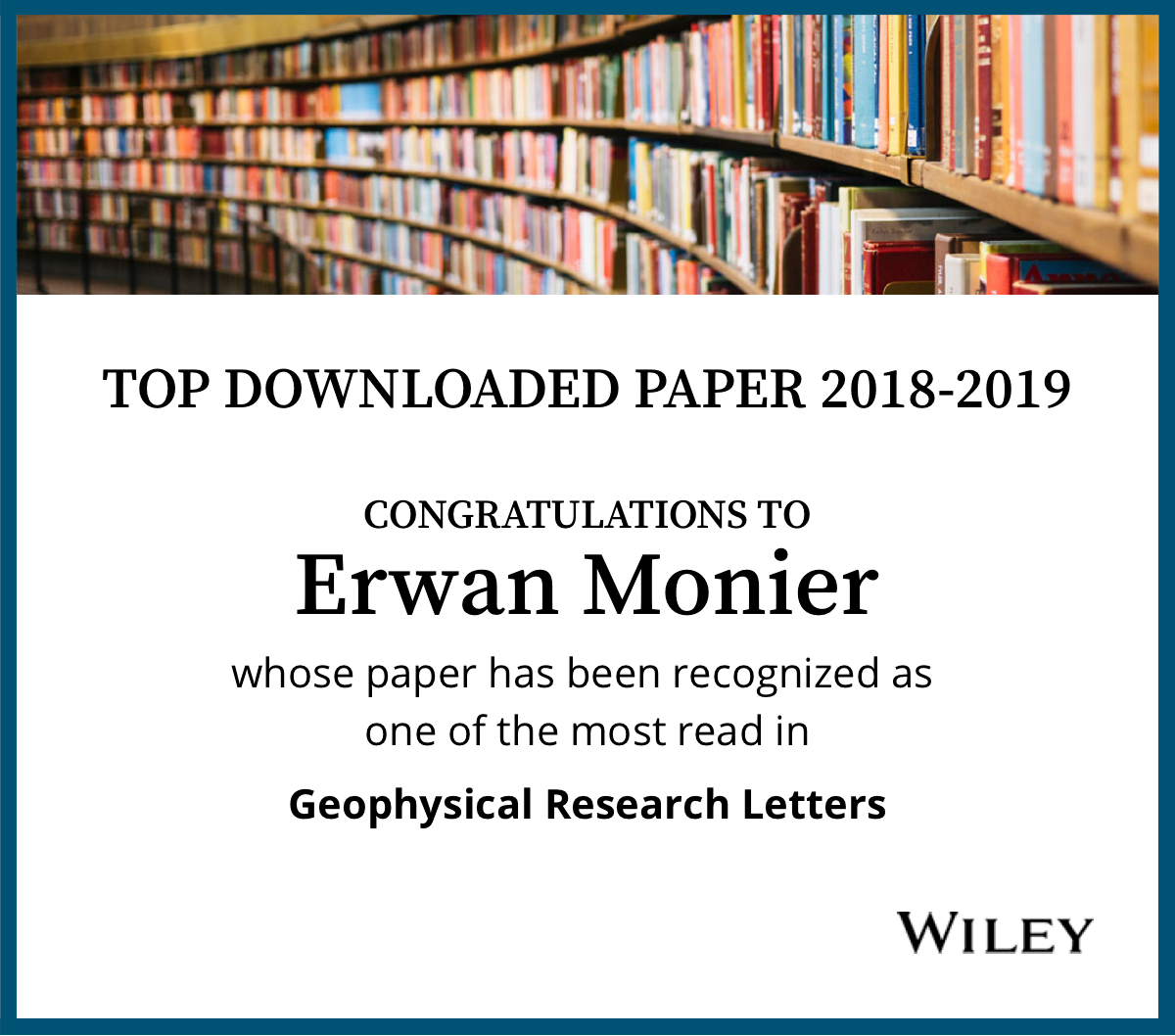
- April 30, 2020: Article co-authored by Erwan awarded "Top downloaded paper of 2018-2019".
- February 12, 2020: Our article on the "Premature mortality related to United States cross-state air pollution", co-authored by Erwan and published in Nature, received a lot of attention from the media including: CNN, The New York Times, Reuters, Scientific American, Science Magazine, U.S. News & World Report, Bloomberg, Boston Globe, Forbes, and MIT News.
- October 30, 2019: MIT News highlights a new MIT Abdul Latif Jameel Water and Food Systems Lab report on climate, agriculture, water, and food security, co-authored by Erwan.
- July 17, 2019: Nature Communications published our work on "Future nitrogen availability and its effect on carbon sequestration in Northern Eurasia" co-authored by Erwan.
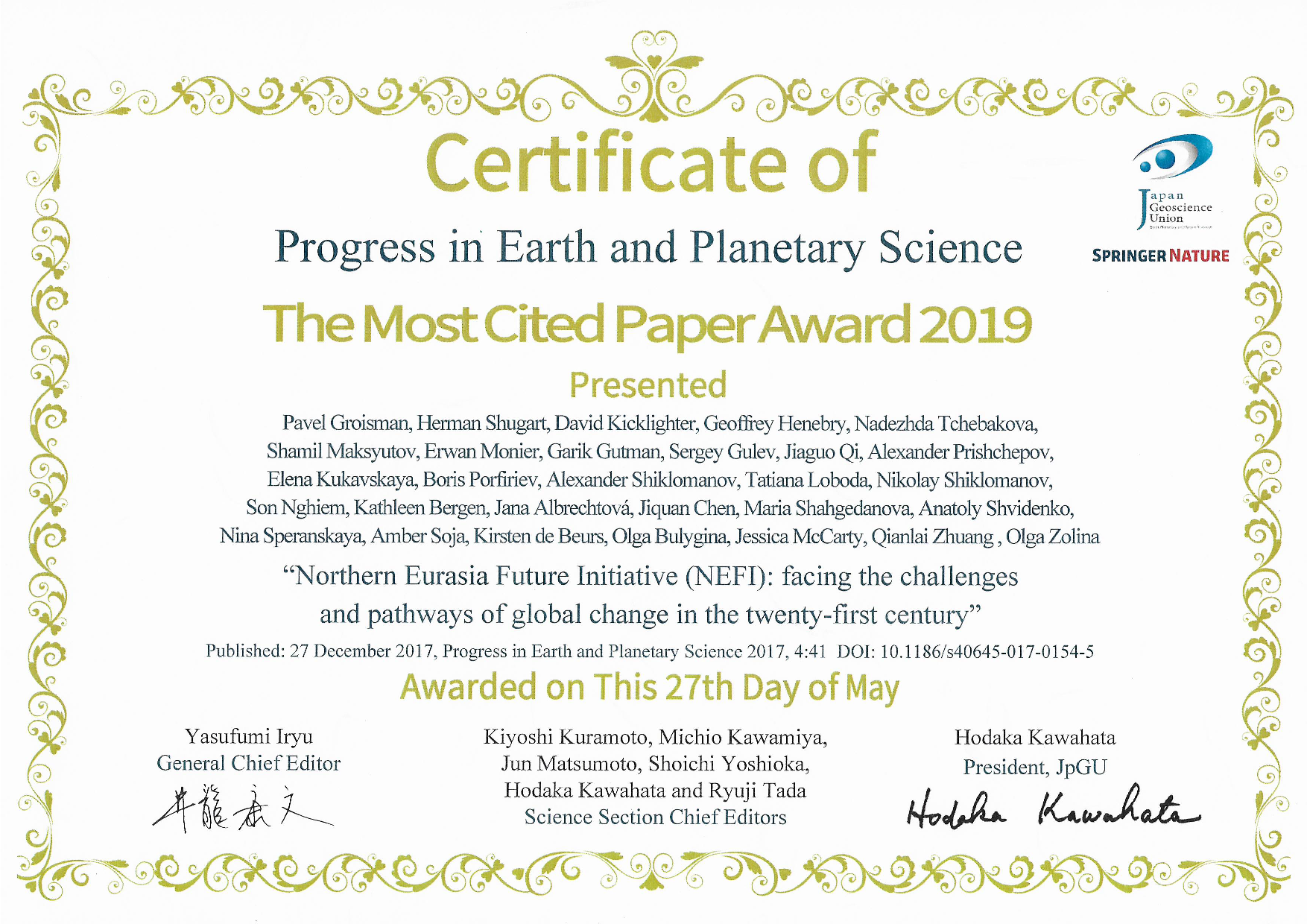
- May 27, 2019: Our article on the "Northern Eurasia Future Initiative (NEFI): facing the challenges and pathways of global change in the twenty-first century", co-authored by Erwan and describing the science foci of the Northern Eurasia Future Initiative (NEFI), a large-scale, interdisciplinary program aimed at developing a better understanding of the interactions between the ecosystem, atmosphere, and human dynamics in northern Eurasia, receives the award for "The most cited paper award 2019".
- April 3, 2019: Popular Science interviews Erwan about the first meeting of the year for the House Subcommittee on Environment and Climate Change.
- February 27, 2019: Article co-authored by Erwan makes the US Department of Energy Science Highlight.
- February 4, 2019: Great media coverage for our article on the "Ocean Colour Signature of Climate Change", co-authored by Erwan and published in Nature Communications: CNN, BBC News, Newsweek, The Guardian, The Telegraph, Forbes, The Washington Post, Fox News, Huffington Post, National Geographic, WBUR News, AAAS EurekAlert!, Sciences et Avenir, and MIT News.